Series Overview
Buddhism: A Journey Through Time is an 8 x 24′ animated documentary series in development, currently seeking co-production and financing partners. The series combines cinematic 2D animation with the research of an international team of scholars based at Oxford University. Designed for global audiences, the series offers a visually compelling approach to science communication, bridging academic research and the public understanding of Buddhism. A five-minute proof of concept and a pitch deck are both available upon request.
Synopsis
Buddhism: A Journey Through Time is a premium animated documentary series designed to present an academically grounded yet widely accessible account of the history and transmission of Buddhist traditions across Asia. Combining cinematic 2D animation with scholarly research, the series traces the origins of Buddhism in the 6th century BCE and follows its spread across South, Central, and East Asia.
Developed in collaboration with specialists in Buddhist studies from universities across Europe and North America, each 24-minute episode explores the interplay between Buddhist traditions and local socio-political systems, examining how Buddhism shaped—and was shaped by—the nations and cultures to which it spread.
Language Versions
The series will be produced in English with planned dubbing and subtitling in major European languages. Additional localization in key international markets (Mandarin, Hindi, and Japanese) will support global distribution across both broadcast and streaming.


Episode Structure
The series is structured as an eight-part journey tracing the historical development and transcontinental spread of Buddhism from its origins in ancient India across Central and East Asia. Each episode focuses on a pivotal region, cultural moment, or network of exchange, using key figures and sites as narrative anchors while maintaining a broad, accessible historical scope.
The narrative unfolds across three acts. The first establishes Buddhism’s emergence on the Gangetic Plain and its early institutional formation. The second follows its transmission along the Silk Roads into Central and East Asia, where it is translated, reinterpreted, and eventually adapted to new cultural and philosophical contexts. The final act explores the emergence of Buddhist traditions in Tibet and Mongolia, positioning them as major centers of innovation.
Across the series, there is a clear geographical progression from India to Central Asia, China, Korea and Japan, and finally Tibet and Mongolia. This mirrors the historical pathways of Northern and Eastern Buddhism over the course of nearly 2,000 years of human history.
Our Art Style
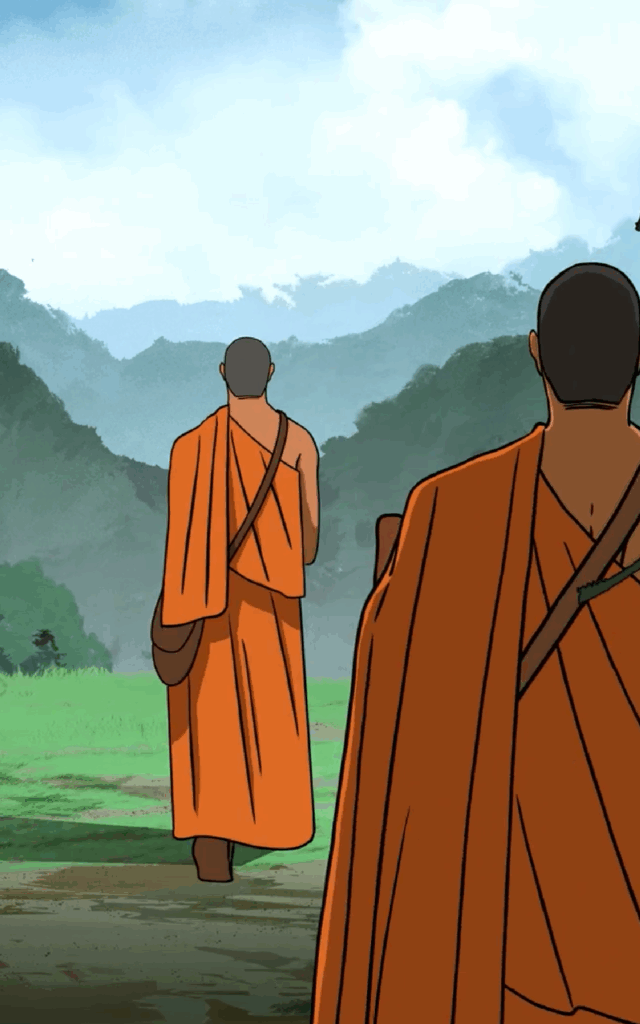
The series will be animated in two distinct styles. The first, depicted in the panel to the right, is a realist style influenced by the tradition of Western anime-inspired animation. This approach foregrounds the material cultures of Buddhist traditions throughout time, emphasizing the historical evolution of monastic robes (kāṣāya) across different Buddhist schools, as well as highlighting the unique architectural styles and real-world locations inherent to each geographical setting.
To achieve this goal, we have formed a braintrust of participating scholars and cultural consultants, based at Oxford University, with whom the art team will work to produce historically accurate representations of the material cultures inherent to each setting. When historical accuracy is not possible (due, for example, to the lack of textual records or archaeological and artistic references), the art team will collaborate with the participating members of the Buddhism: A Journey Through Time braintrust to find creative and culturally faithful approaches to representing locations and characters.

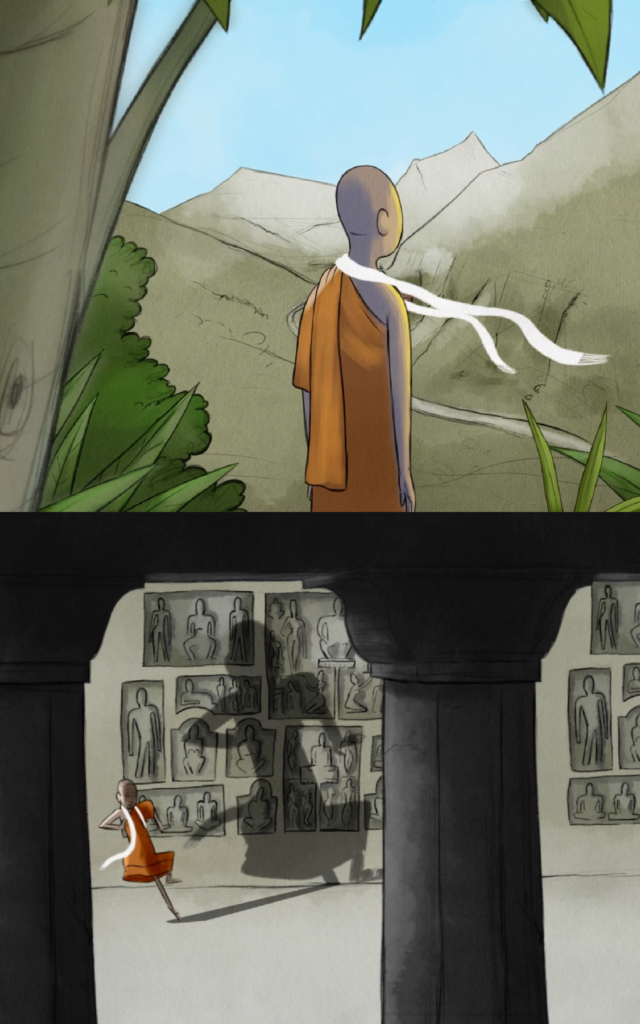
The series’ second animation style, depicted in the panels to the left, is considerably more abstract in tone. It will be realized using an approach to 2D hand-drawn animation that simplifies both character design and background design to achieve a ‘dream-like’ visual key. We intend to use this second style to represent selected episodes from Buddhism’s cultural history, including myths, folktales, and narratives translated from various Buddhist historiographical traditions.
The shift from a realist to a more abstract style of animation is meant to signify to the viewer that we are moving into a different kind of narrative space — one which is not necessarily grounded in the meticulous details of materialist history; but which is nonetheless essential to developing a holistic understanding of Buddhist history across cultures.
By blending these two animation styles, we intend to draw the viewer into a braided narrative in which the material forces that shaped Buddhism over time (e.g. the social, economic, and political forces that influenced the development of Buddhism) co-exist and are woven together with a scholarly commentary on the ways in which different cultures and languages helped to define the distinct schools of Buddhism as they exist today.

Production Model and Distribution
The series is being developed as an international co-production led form Germany, with a flexible production model designed to engage partners across multiple territories. Development and pre-production are coordinated by Ligature Historical Filmwerke in collaboration with an international academic advisory group, while animation production and post-production are structured to accommodate co-producing studios within Europe and the UK. This approach is intended to maximize eligibility for national funding schemes, tax incentives, and European support mechanisms while allowing for a scalable pipeline aligned with partner expertise and creative contribution.
The project is conceived for international distribution, with an English-language primary version supported by high-quality dubbing and subtitling in major European languages. The series is positioned for premium factual broadcasters and streaming platforms, with a particular focus on outlets specializing in documentary, history, and cultural programming, including public broadcasters and global streaming services, with strong potential for educational and institution distribution.

Director’s Note
This project begins from a simple conviction: the history of Buddhism is world history. It is a shared human story that remains largely inaccessible outside of academic contexts. My intention is to create a premium animated documentary series that brings the global history of Buddhism to a wider audience without diminishing the intellectual depth of the subject.
Animation allows us to reconstruct historical worlds that no longer exist, moving beyond the limits of archival documentary to create an immersive, emotionally resonant form of nonfiction storytelling. Visually, the series combines historically grounded character animation with stylized sequences that draw from the material cultures of different Buddhist societies, allowing the visual language of the series to shift in response to different historical eras and different Buddhist traditions across Asia.
The series sits at the intersection of historical documentary and cinematic animation, drawing inspiration from works like Cosmos: A Spacetime Odyssey and The Ascent of Man—documentaries that combine visual ambition and narrative depth.
Our team

Alexander K. Smith
Producer | Director
Alexander is a historian, socio-cultural anthropologist, and filmmaker. He holds a PhD in Tibetan and Himalayan Studies from the University of Paris, France (EPHE-PSL), and an MA from Oxford University. As a writer, director, and producer, he has worked on two documentary projects: a feature film, titled The Rise and Fall of the Tibetan Empire (2024), which is currently available on Tricycle: The Buddhist Review’s streaming service and The Animated History of Tibet (2023-2025), an animated historical documentary series, which is available to watch on YouTube.

Allissoon Lockhart
Co-Producer
Allissoon is an animation producer with over 13 years of experience working in television, film, and game cinematics. She has produced and consulted on multiple series and feature projects, with credits spanning Netflix, HBO Max, and international studios. Based in Tokyo, she develops and produces original IP while collaborating with creators and studios worldwide.

Elaine Lai
Writer
Elaine is a scholar of Buddhism and a storyteller. She holds a PhD from Stanford University, an MA from the University of Hong Kong, and is a graduate of the Beijing Film Academy. She currently works as a Lecturer for Stanford University and has written and produced two short films, two audio plays, two feature length screen plays, and three TV pilots that span the genres of comedy, drama, historical fiction, and AI ethics.

Jan Westerhoff
Lead Academic Advisor
Jan Westerhoff is Professor of Buddhist Philosophy and a Fellow of Lady Margaret Hall at the University of Oxford. He holds doctorates from the University of Cambridge and the School of Oriental and African Studies, University of London. In addition to his teaching and research, he is the author of numerous articles and books on the history of Buddhism, including, most recently: The Non-Existence of the Real World (2020), The Golden Age of Indian Buddhist Philosophy (2018), and Nāgārjuna’s Madhyamaka: A Philosophical Introduction (2009).
– Participating Scholars –
Professor Jan Westerhoff
(Oxford University)
Jan Westerhoff is Professor of Buddhist Philosophy at the University of Oxford. His research focuses on the Buddhist philosophical traditions of India and Tibet, especially on Madhyamaka. His books include Ontological Categories (2005), Nāgārjuna’s Madhyamaka (2009), The Dispeller of Disputes (2010), Twelve Examples of Illusion (2010), Reality: A Very Short Introduction (2011), and The Golden Age of Indian Buddhist Philosophy (2018), all published by Oxford University Press.
Professor Ulrike Roesler
(Oxford University)
Ulrike Roesler obtained a PhD in Indian Studies from the University of Munster, Germany, and her Habilitation in Tibetan Studies from the University of Munich. Roesler’s research interests are in the early history of Buddhism in Tibet, interactions between India and Tibet, Tibetan biographical writing, narrative literature, and the notion of sacred landscapes in the Himalayas. Her most recent book publication is the volume Lives Lived, Lives Imagined: Biography in the Buddhist Traditions (Wisdom Publications 2010).
Professor Jin Park
(American University)
Park currently serves as President of the American Academy of Religion and President of the North American Korean Philosophy Association. She previously served as President of the Society for Asian Comparative Philosophy from 2018 to 2019. Parks research in Buddhism focuses on the Zen and Huayan schools of East Asian Buddhism, with particular attention to the issues of language, violence, and ethics. In her comparative studies, she engages Zen and Huayan Buddhism alongside postmodern thought in continental philosophy.
Professor Georgios Halkias
(University of Hong Kong)
Georgios T. Halkias is a Greek Scholar of Oriental Studies with publications on Tibetan Buddhism, Himalayan regions, and cross-cultural contacts between Hellenism and Buddhism. He is currently an associate professor of Buddhist Studies at the University of Hong Kong and co-editor in chief of the Oxford Encyclopedia of Buddhism.
Professor Lars Folgen
(University of Arizona)
Lars Fogelin is Associate Professor of Anthropology at the University of Arizona. He is a specialist in the archaeology of Buddhism in South Asia. He also engages in broader research on the archaeology of religion, architecture and the application of the philosophy of science to archaeology. He is the author of The Archaeology of Early Buddhism (2006) and An Archaeological History of Indian Buddhism (2015) among other works.
Professor Cuong Mai
(Appalachian State University)
Cuong Mai specializes in the religions of Asia, particularly the history of Chinese and Vietnamese Buddhism. He completed his undergraduate degree in Religious Studies at Columbia University, an MA at the University of Hawaii, and a PhD in Religious Studies at Indiana University, Bloomington. He previously taught at the University of Vermont in the Department of Religion.
Professor Sangseraima Ujeed
(University of Michigan)
Sangseraima Ujeed, Assistant Professor of Tibetan Buddhism, University of Michigan, Ann Arbor, received her MSt and DPhil degrees in Oriental Studies from the Department of Tibetan and Himalayan Studies, Faculty of Oriental Studies, University of Oxford. Her main research focus is the trans-national, trans-regional, and cross-cultural aspects of Buddhism, lineage, translation, monastic and reincarnation networks, and identity in Tibet and Mongolia in the Early Modern Period, with an emphasis on the contributions made by ethnically Mongolian monk scholars.
Prof. Vensa Wallace
(UCSB)
Vesna A. Wallace teaches South Asian and Inner Asian religions and advanced Sanskrit Courses in the Department of Religious Studies at UCSB. Her two areas of specialization are Indian Buddhism, particularly Mahāyāna and Vajrayāna traditions, and Mongolian Buddhism. She has authored and translated four books related to Indian Buddhism, three of which pertain to the Kalachakra tantric tradition in India, and has published numerous articles on Indian and Mongolian Buddhism. Her most recent book is an edited volume on Mongolian Buddhism, titled Buddhism in Mongolian Culture, History, and Society.
Prof. Fabio Rambelli (University of California Santa Barbara)
Fabio Rambelli is professor of Japanese religions and the International Shinto Foundation endowed chair in Shinto Studies at the University of California, Santa Barbara. His books include Buddhist Materiality (2007), The Sea and the Sacred in Japan: Aspects of Maritime Religion (2018), and Spirits and Animism in Contemporary Japan (2019). He works at the intersection of philosophical discourses, material practices, and everyday life in premodern Japan.
Dr. Daniel Wojahn
(Oxford University)
Daniel Wojahn recently finished his PhD in Tibetan and Himalayan studies at the University of Oxford, where he was a Leverhulme scholarship holder and a 2023 Robert H. N. Ho Family Foundation Dissertation Fellow in Buddhist studies. He received his baccalaureate and MA in Indology and Central Asian Studies from Leipzig University, Germany. He is also the digital content lead of the Oral History of Tibetan Studies project. Daniel’s current research focuses on the intersection of power and law during the Yuan-Sakya period in pre-modern Central Tibet.
Dr. Dominic Steavu (University of California Santa Barbara)
Is a faculty member in the Department of East Asian Languages and Cultural Studies at the University of California Santa Barabara. His area of specialization is the history of Daoism and Chinese Buddhism with a focus on the history of medicine. He has written numerous books and articles on East Asian religions, including, most recently, The Writ of the Three Sovereigns: From Local Lore to institutional Daoism (2019) and Transforming the Void: Embryological Discourse and Reproductive Symbolism in East Asian Religions (2016).